Wear Basic Sweaters Well
Mukesh Kumar
| 25-08-2026
 · Lifestyle Team
Hi, and welcome. A basic sweater sounds easy, but that's exactly where a lot of outfits go flat.
You put on a plain crewneck, plain trousers, plain shoes, and the whole thing feels quiet in the wrong way. The fix is not loud color or extra pieces for no reason.
It's choosing a sweater that fits cleanly, then giving it structure with details you can actually see, such as a crisp oxford shirt, fuller trousers, or a shoe with some presence.

Fit carries the whole look
A sweater usually looks dull when the shape is off, not when the design is too simple. If the shoulder seam drops too far past your shoulder, the piece looks slack. If the body is too tight around your midsection, it looks strained and makes layering harder. A better move is a fit that skims your frame, with enough room for a T-shirt or button-up underneath. A classic crewneck in merino works well here because the knit is smooth and the neckline stays neat. A heavier lambswool version can work too, especially if you want a little more shape through the body and sleeves. You should also pay attention to length. If the hem lands around your waistband, the proportions stay tidy with jeans or chinos.
Texture keeps simple interesting
A plain sweater does not need graphics to hold attention, but it does need some surface character. That's why a cable knit, a brushed lambswool knit, or even a ribbed hem and cuff can make a basic piece feel more considered. A fine merino sweater looks clean under a blazer, while a thicker Shetland-style knit has enough texture to stand on its own with simple trousers. The point is small contrast you can notice right away. A navy cashmere crewneck with gray wool trousers reads differently from a flat, thin knit paired with equally flat pants. You are still wearing basics, but the outfit has more shape and more visual separation.
Layers do the hard work
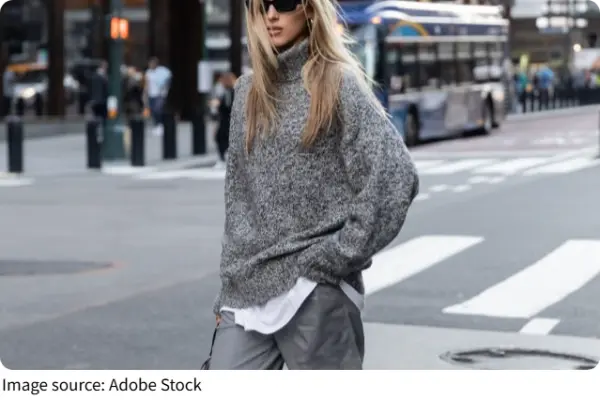
A sweater on its own can look spare, but layered properly it starts to feel complete. One reliable option is a crewneck over an oxford shirt, with the collar and shirt hem showing just enough to break up the knit. Another is a quarter-zip worn over a plain tee, then opened slightly so the neckline does not look closed off. If you wear a V-neck, it tends to look stronger over a collared shirt than by itself, especially in office settings. Outer layers matter too. A basic gray sweater under a dark chore coat has more shape than the same sweater worn alone. A navy knit under a tweed jacket does something similar. You are not adding clutter, you are giving the sweater edges and context.
Color needs some contrast
Most men start with navy, gray, camel, or black, and that part makes sense. Those colors are easy to repeat. But if the whole outfit stays in one low-contrast lane, the result can feel washed out. A charcoal sweater with black trousers often needs a sharper shoe, a brighter shirt, or a coat in a different tone to keep the outfit defined. A camel sweater, for example, has more presence with dark denim or olive trousers. A navy sweater gets clearer when you pair it with off-white chinos or mid-gray wool pants. Even a simple white T-shirt peeking out at the collar can help. You do not need a bright palette, just enough difference between one piece and the next.
A basic sweater works the same way a plain white shirt works, it depends on everything around it. If you get the fit right, choose a knit with some texture, build in one or two layers, and give the color palette a bit of contrast, the sweater stops fading into the background. You still look simple, just not forgettable. So next time you reach for that standard crewneck or quarter-zip, don't replace it, style it with more intention and you'll see the difference right away.